AI Research Foundations · Post-workshop period
Capstone Project Hackathon
Work in pairs to build a machine learning solution to a real-world problem in your own context, following the Responsible Innovation Roadmap in Course 08.
Overview
Build your AI solution for real-world impact
During the post-workshop period, you and a partner from your cohort build a machine learning solution to a real-world problem in your own context. You apply responsible innovation practices from problem definition through to implementation, following the roadmap you walked through during the workshop.
Who takes part
All AI Champions and TAs in each cohort.
Teams
Pairs within the same cohort.
Categories
Classification, summarisation, conversational assistant, a combination of two, or your own path.
Deliverables
A capstone project proposal, and a GitHub repository or Google Drive folder with your implementation.
Recognition
The top three projects in each cohort are recognised.
Support
Contextualised datasets, code recipes, and technical support on Discord.
Course 08
The Responsible Innovation Roadmap
Every pair follows the same eight steps, from the problem you want to solve to a full plan you can share. Course 08 on Google Skills walks you through each one.
Open Course 08 on Google Skills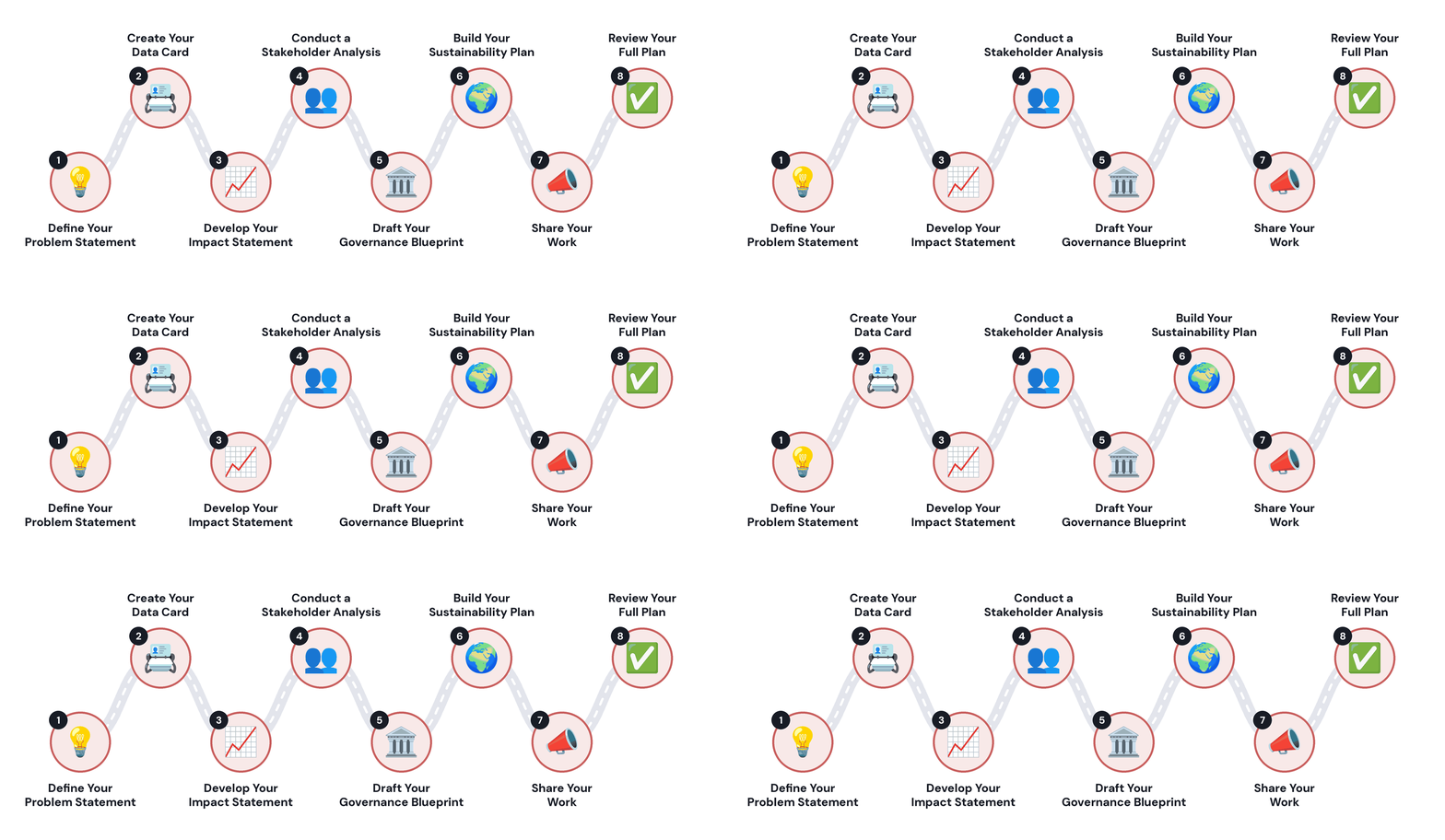
Your way into the Community of Practice
Completing all the available courses and your capstone project during the post-workshop period is a prerequisite for joining the Community of Practice.
Capstone Project Roadmap
Your capstone, step by step
- 1
Form your pair
Team up with another AI Champion or TA from your cohort and register your pair.
- 2
Choose your idea
Pick a project category and a real-world problem that matters in your context.
- 3
Follow the Responsible Innovation Roadmap
Work through the eight steps in Course 08, from your problem statement to your full plan.
- 4
Submit your capstone project proposal
A document covering your problem statement, data collection plan, impact statement, stakeholder analysis, governance blueprint, sustainability plan and a one-sentence elevator pitch.
Deadline: Two weeks before your post-workshop period ends - 5
Build and submit your implementation
A GitHub repository or Google Drive folder with your code, Colab notebooks, data card, model card and any other documentation. GitHub is highly recommended, but Google Drive is also accepted.
Deadline: The end of your post-workshop period - 6
Judging and recognition
The AIMS South Africa team judges the projects and selects the top three in each cohort. FATE Foundation organises the recognition.
- 7
Join the Community of Practice
Completing all the available courses and your capstone project unlocks your place in the Community of Practice.
The eight roadmap steps
Define your problem statement
The problem, who it affects and why it matters in your context.
Create your data card
Where your data comes from, what it contains and its limitations.
Develop your impact statement
The change your solution should make and how you will measure it.
Conduct a stakeholder analysis
Who is affected by or has influence over your solution.
Draft your governance blueprint
How risks, privacy and accountability will be managed.
Build your sustainability plan
How the solution can be maintained and grow after the hackathon.
Share your work
Present your plan and solution to others.
Review your full plan
Check that every part is complete and consistent before you submit.
Submit your proposal
Due no later than two weeks before your cohort's post-workshop period ends.
Link coming soonSubmit your implementation
Due by the end of your cohort's post-workshop period.
Link coming soonTeam formation
Find your partner
Work in pairs
Every capstone project is built by two people: AI Champions, TAs, or one of each.
Stay in your cohort
Both partners come from the same cohort. Your partner can be from your own university or another university in your cohort.
Study buddies too
Your partner is also your study buddy: keep each other on track to complete all the available courses before your deadline.
Tips for a strong pair
- Choose a partner whose skills complement yours, for example one stronger in coding and one in the problem domain.
- Agree early on when and how you will meet, and share the eight roadmap steps between you.
- Pick a problem you both care about and can find or create data for.
Register your pair
Once you have a partner, register your pair so the team knows who is working together.
Link coming soonJudging criteria
How projects are judged
The AIMS South Africa team judges submitted projects and selects the top three in each cohort, considering:
- 01
Impact
The potential impact of the proposed solution on its target users and their local context.
- 02
Responsible innovation
How well responsible innovation practices are applied to assess the risks, potential harms, fairness, privacy, stakeholders and sustainability of the solution.
- 03
Dataset
Uses a relevant, well-sourced dataset (existing, collected or synthetic) and documents it in a data card.
- 04
Model
Uses a relevant model or machine learning technique, with a model card covering its architecture, intended use, training data, evaluation results, limitations and risks.
- 05
Clean coding practices
Clear structure, comments and reproducible steps, whether in Google Colab or Python scripts.
Recognition
The top three projects in each cohort will be recognised by FATE Foundation, and outstanding projects will be spotlighted in the Community of Practice.
Deadlines
Submission deadlines by cohort
Proposals are due two weeks before your post-workshop period ends; implementations are due on its last day.
| Cohort | Post-workshop period | Capstone proposal | Implementation |
|---|---|---|---|
| 🇳🇬 🇬🇭 Nigeria Cohorts 1 and 2, Ghana Cohort | 19 Oct to 15 Nov 2026 | 1 Nov 2026 | 15 Nov 2026 |
| 🇰🇪 🇿🇦 Kenya Cohort 1, Pretoria Cohort | 19 Oct to 29 Nov 2026 | 15 Nov 2026 | 29 Nov 2026 |
| 🇰🇪 Kenya Cohort 2 | 26 Oct to 6 Dec 2026 | 22 Nov 2026 | 6 Dec 2026 |
| 🇿🇦 Western Cape Cohort | 16 Nov to 27 Dec 2026 | 13 Dec 2026 | 27 Dec 2026 |
| 🇳🇬 Nigeria Cohorts 3 and 4 | To be confirmed | To be confirmed | To be confirmed |
Project ideas
Choose your path
Classification
Develop a language model or machine learning model for classification.
Example A maternal health SMS urgency classifier for community health workers in rural Kenya 🇰🇪
Summarisation
Develop a language model or machine learning model for summarisation.
Example A news headline generator for Swahili news 🇰🇪
Conversational assistant
Develop a chatbot or assistant that generates free-text responses to users' questions.
Example A personalised tutor for WAEC exams with support for Nigerian and Ghanaian languages 🇳🇬 🇬🇭
Combine two paths
Bring two categories together in one solution.
Example A customer support bot for ABSA 🇿🇦 that classifies the intent and urgency of a request in Zulu, then sends a solution
Your own path
Build any other project that solves a real-world problem in your context, using a machine learning model and responsible innovation practices.
More ideas to spark yours
Start from a recipe
Each recipe is a complete, working project you can run in Google Colab, then adapt to your own problem, language and data.
Resources
You don't have to start from scratch
Course 08 on Google Skills
The capstone course: it walks you through every step of the Responsible Innovation Roadmap and how to develop each part of your proposal.
Open Course 08Capstone code recipes
End-to-end recipes from the AIMS South Africa team. Each one runs in a single Google Colab notebook on a free GPU, with a completed run to compare against.
Open the recipes on GitHubCapstone datasets
Ready-to-use, contextualised datasets in English and African languages, so you don't have to start from scratch.
Browse the capstone datasetsTechnical support
A dedicated #capstone-project channel will be created on each cohort's Discord server for your capstone questions. Report technical problems in #report-an-issue, and ask about the course material in #help-desk.
How to create your dataset?
A practical, step-by-step guide for beginners
How to Create a Dataset for Your AI Project
Learn how to source, collect, generate, organise, validate, and document data for an AI project.
FAQ
Frequently asked questions
Can I work on my own?
No. Capstone projects are built in pairs, with both people from the same cohort. Your partner also doubles as a study buddy for the remaining courses.
Can my partner be from another university?
Yes, as long as you are both in the same cohort.
When are our deadlines?
Your proposal is due no later than two weeks before your cohort's post-workshop period ends, and your implementation by the end of it. See Deadlines for your cohort's dates.
Which dataset can we use?
You can use any relevant, well-sourced dataset. This could be an existing public dataset from platforms such as Zindi, Kaggle, or Hugging Face; a dataset you collect manually; or a synthetically generated dataset.
Make sure you document the dataset in a data card, including its source, purpose, contents, and any relevant limitations or considerations.
Do we have to use GitHub?
GitHub is highly recommended, as version control is a useful skill, but submissions through Google Drive are also accepted.
Who judges the projects?
The AIMS South Africa team judges the submitted projects and selects the top three in each cohort, using the judging criteria on this page.
What happens when we finish?
Completing all the available courses and your capstone project during the post-workshop period is a prerequisite for joining the Community of Practice, where outstanding projects will also be spotlighted.
Where can we get help?
A dedicated #capstone-project channel will be created on each cohort's Discord server for your capstone questions. Report technical problems in #report-an-issue, and ask questions about the course material in #help-desk.
Anything else? Email ai-research-foundations@aims.ac.za.